
Lately, I’ve been noticing a pattern amongst the crowd. The pattern of repetition: believing that opinions we’ve formed are truly our own. We like to imagine that we see something, think about it, process it through the sophisticated machinery of our magnificent human brains, and eventually arrive at an independent conclusion.
“I like this movie.” “I hate this character.” “This song is shit.” “This game is underrated.” “This might be the greatest TV show ever made.”
We say these things quite confidently. As if somewhere inside our minds, there’s Papa Smurf carefully reviewing our analysis before allowing us to have an opinion. Except there isn’t. Sometimes there’s just a guy watching an Instagram Reel at 2:37 AM who has been told, for the fifteenth time, that a movie he enjoyed is actually terrible. And eventually he goes;
“You know what? Fuck it, I hate this movie now.”
This is something I’ve personally become increasingly interested in: the strange possibility that some of our opinions are not formed as much as they are assembled. We experience something, have an immediate reaction to it, and then proceed to expose ourselves to hundreds of thoughts of other people’s reactions until those reactions begin to seep into our own. At some point, the difference between “I think this” and “I have repeatedly seen people say this” becomes surprisingly difficult to locate.
The truth is, we have been borrowing from each other long before social media came along and gave us a faster way of doing it. We borrow words to explain feelings we had before we knew what to call them. We borrow ideas to make sense of things we couldn’t quite understand. That’s why writers, poets, philosophers, and scholars exist: people before us have spent their lives trying to make sense of things that our own minds might otherwise consider completely diabolical.
So, one day, I was curious and went surfing through Google to find out if there’s a specific term for this, and behold, I found: The Bandwagon Effect.
It’s a psychological phenomenon in which people adopt a belief or behaviour partly because they see other people doing or believing it. It doesn’t necessarily matter whether their beliefs originally aligned with the choice. They see the crowd moving in one direction and, sometimes consciously and unconsciously, begin moving with it.
There are two main examples I can give you for this:
Movies and music. You enjoy a movie. Then you see hundreds of people calling it terrible. Eventually, you start noticing every flaw they pointed out. The movie hasn’t changed. But your interpretation of it has.
Trends and characters. You don’t care about a character. Then you see a really good Reel of them. The music hits, the cinematography looks incredible, the comments are full of people saying “PEAK” and “GOAT,” and suddenly you’re wondering why you didn’t think the character was cool in the first place.
That last one sounds stupid but it is also probably more powerful than we realise. In my last essay, I talked about my experience dating people with BPD. I talked about people turning mental illness into an aesthetic. Today, there are thousands of women on social media who’re apparently bad bitches with BPD, doesn’t matter if they’re clinically diagnosed or not.
It’s like the salem witch trials; If you don’t like someone, convince everyone they’re a witch and they’ll get burned. Similarly, convince a person they’re insane enough and everyone will get on board calling them insane.
The Human Brain Has Been Doing This Long Before Instagram
It would be easy to blame Instagram or any other social media platform because playing the blame game is easier. But humans were doing this long before Mark Zuckerberg decided we needed 4K videos of influencers making content aimed at gooners.
Solomon Asch’s famous conformity experiments demonstrated how strongly group judgment can influence individual responses. People were asked to compare line lengths while other people deliberately gave incorrect answers. Even when the correct answer was obvious, the people sometimes followed the group’s incorrect response.
The important part isn’t that people are stupid. It’s that other people become part of our evidence. Asch only needed a handful of actors in a room to get people to doubt their own eyes. Social media just replaced the room with fifty thousand strangers who never leave.
The Edit Effect
This is probably my favourite example because it is simultaneously hilarious and slightly horrifying.
Someone takes a character you originally didn’t care about and makes a thirty-second edit with perfect music, dramatic lighting, and just the right selection of scenes. The comments are filled with people calling the character a genius, a legend, the greatest character in the series. Suddenly you’re looking at the same character and wondering whether you’ve been missing something. The character hasn’t changed, but the Frame has.
The edit has removed the boring moments, highlighted the impressive ones, and surrounded the character with an emotional context that tells you how you’re supposed to feel. Social media does this constantly. It takes cultural objects and reframes them until the framing can become difficult to separate from the thing itself.
Fun Fact: This is how I was peer pressured into watching Game of Thrones.
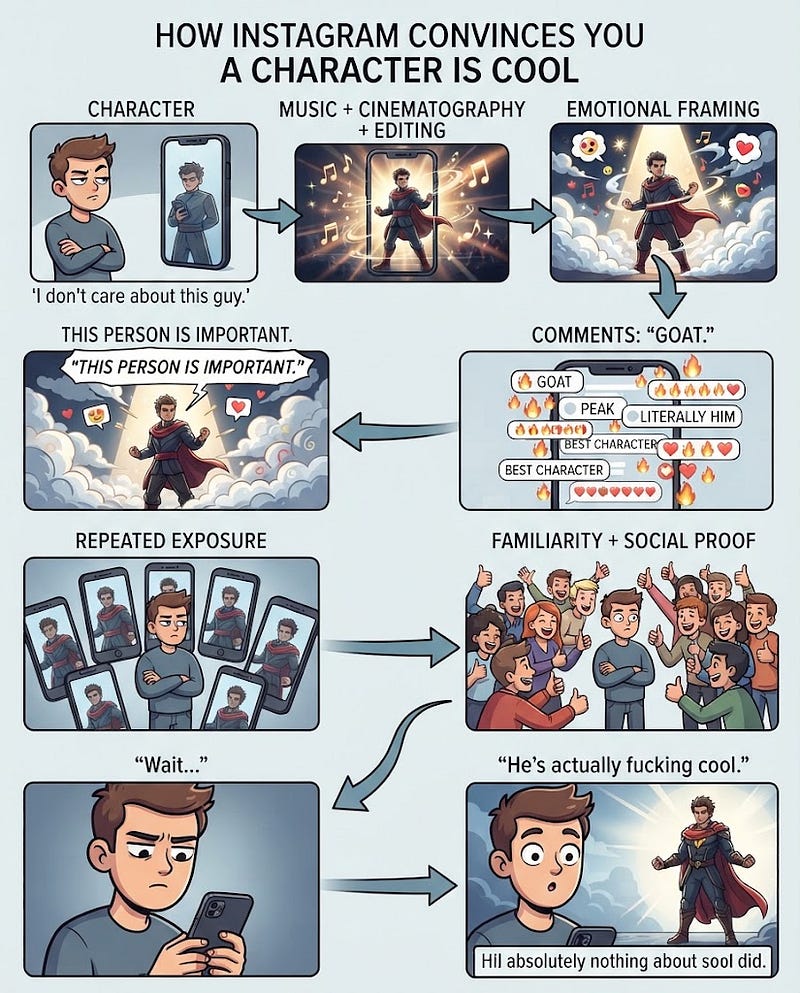
Yes, I made this with Gemini because I don’t care much for artwork. Bite me.
Is that really your Opinion?
Here is where things become genuinely uncomfortable. What happens when you cannot remember why you believe something? You ask someone why they hate a movie.
“Because it’s shit.”
“Okay, but what specifically?”
“The acting.”
“Which part?”
“I don’t know. It’s just bad.”
Sometimes there is a perfectly legitimate reason underneath this. But sometimes I wonder whether the opinion arrived first and the explanation came afterwards.
I remember when the first Suicide Squad movie came in 2016. Back then, the narrative was that Jared Leto’s portrayal of the Joker was bad. I saw many posts like:
Jack Nicholson: The Gangster
Heath Ledger: The Terrorist
Jared Leto: The Joke
And because everyone seemed to agree, I believed the same opinion. The funny thing is that, years later, I actually like Leto’s portrayal. Was it perfect? No. The movie itself had a rushed development, a messy script, and Leto wasn’t given much screen time to actually do anything with the character. But I had never really stopped to ask myself why I thought his Joker was bad in the first place. I had simply accepted that he was. That is the part that bothers me. I didn’t change my mind because someone gave me a brilliant argument. I changed my mind because I eventually realised I had never properly formed the first opinion myself. I was part of the same hypocrisy as everyone else.
Are We Forming Opinions or Selecting Them?
This is the question I keep coming back to. When I say, “I hate this,” what exactly happened?
Did I independently evaluate it? Did I think carefully about what I disliked? Or did I encounter it, see hundreds of people mocking it, watch enough content framing it as embarrassing, and eventually absorb the general sentiment?
The honest answer is probably somewhere in between. Our opinions aren’t fake, but they aren’t formed in a vacuum either. We are social creatures. Other people’s reactions have always influenced us. Culture itself is essentially an enormous system of people influencing other people until certain things become normal, desirable, offensive, fashionable, embarrassing, or cool.
The difference now is scale and speed. Your cultural environment used to consist mostly of the people around you, newspapers, books, radio, and whatever eccentric bastard lived down the street and had strong opinions about jazz. Now you can wake up and encounter 40,000 people who have already decided what you should think about a television show that aired yesterday.
But there is an important distinction here. Other people’s opinions can genuinely teach us something.
Someone can point out symbolism we missed. Someone can explain a character’s behaviour. Someone can introduce us to a song we would never have discovered alone. Someone can make an argument good enough to change our mind. That isn’t necessarily a problem. The problem begins when we stop using other people’s opinions as information and start using them as instructions.
There is a difference between:
“I hadn’t thought about it that way.”
and
“Everyone thinks that, so I guess I think it too.”
The former is learning, whereas the latter is outsourcing. And outsourcing an opinion is its own small philosophical suicide: accepting the crowd’s answer because it’s easier than sitting with your own uncertainty about what you actually think.
Maybe Your Opinion Is Still Yours
There is a simple experiment you can perform the next time you catch yourself suddenly loving or hating something.
Ask yourself:
What did I think before I saw everyone else’s opinion?
If you watched the movie before reading the reviews, what did you think? If you heard the song before seeing the TikToks, did you like it? If you changed your mind, what actually changed it?
Was it new information? A better argument? A different interpretation? Or did you simply encounter the same opinion often enough that it started sounding like your own voice?
That distinction matters. The goal isn’t to have opinions that nobody else has. That would be fucking exhausting. Nor is the goal to become some contrarian bastard who automatically believes the opposite of whatever everyone else says just to feel independent.
Perhaps the goal is simply to know which parts of our opinions we actually examined ourselves.
We can listen to the crowd without becoming the crowd. We can change our minds without pretending we always believed the new thing. We can love something unpopular without needing an edit to validate it. Because maybe the problem isn’t that other people influence us.
Maybe the problem is that we sometimes forget they did.
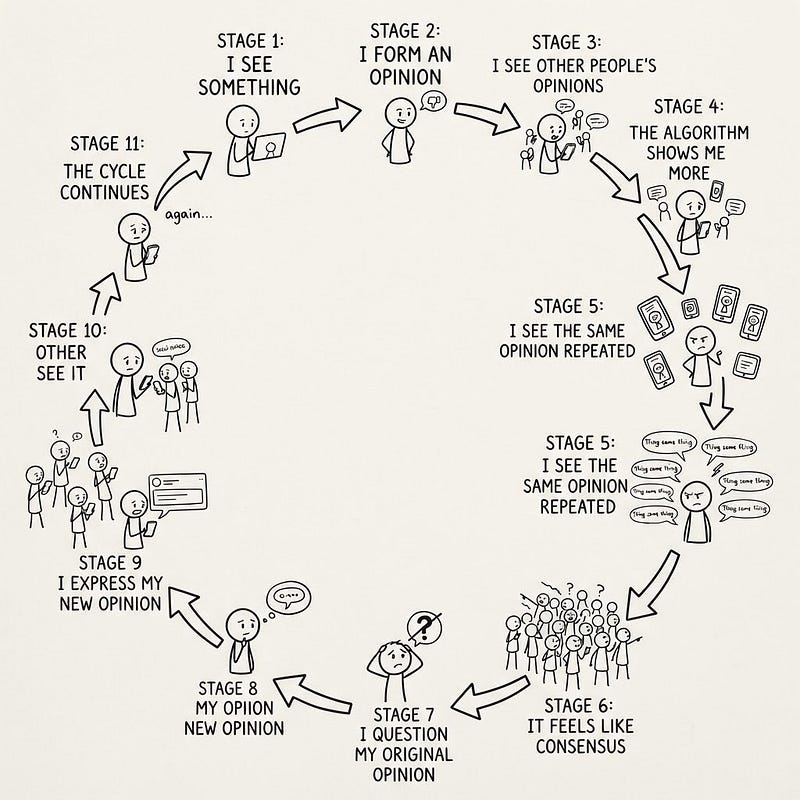
The Cycle Repeats (Yes, I know Stage 5 is repeated twice but it’s 4 AM and I’m too tired to edit it out. (You get the point.)
I’ll Wait for the Reel
The funniest thing about all of this is that I am not standing outside the system. I’m writing this because I noticed myself doing it. I’ve watched something and enjoyed it, only to encounter enough criticism that I began questioning why I enjoyed it. I’ve disliked a character and then watched somebody make an absurdly good edit of them and suddenly thought, “Wait a fucking minute.” I’ve discovered songs through edits and subsequently convinced myself that I had always liked them.
And I’m probably going to do it again.
Because knowing about a psychological phenomenon doesn’t magically exempt you from being human. I can know about social proof and still fall for social proof. I can know about conformity and still conform. I can know that social media is a distorted representation of reality and still scroll through the comments and think, “Holy shit, everyone agrees.”
Maybe that is the most interesting part. We like to imagine that knowing how the machine works makes us immune to it. It doesn’t. The machine is still running. The Reel is still loading. The comments are still telling us what everyone thinks. And somewhere between the 17th edit, the 42nd meme, and the 900th person calling the movie “peak cinema,” I may once again find myself staring at my phone, reconsidering an opinion I had five minutes ago. I don’t know whether I like this or not. I’m waiting for an Instagram Reel to tell me.
If You Enjoy This Kind of Writing
I write about the strange little things that make us human: the opinions we form, the people we become, the things we desire, and the ways culture, psychology, relationships, and the internet quietly shape us.
Sometimes it’s an essay about something I can’t stop thinking about. Sometimes it’s a story about something much darker. Sometimes it’s just me staring at an ordinary part of life and wondering why the hell we behave the way we do.
If that sounds like your kind of rabbit hole, follow along on my medium!